Wireless Communication, Poka-Yoke, Line Control and Smart Data Processing
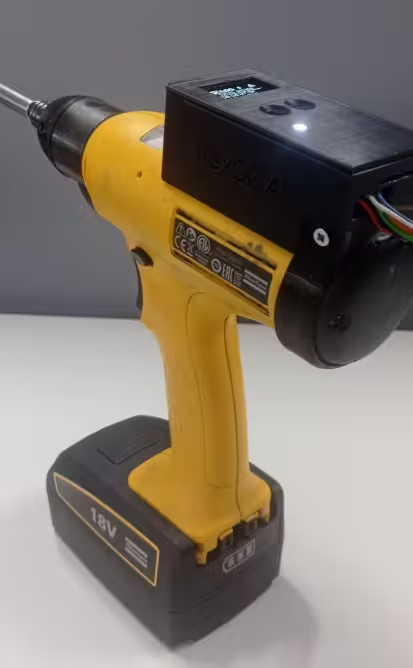
In modern automotive production lines, quality, traceability, and process safety are becoming increasingly critical. Within this scope, I actively worked on the smart station solution used at the TOFAŞ factory, focusing on wireless communication, error-proofing mechanisms, and data-driven line control.
Throughout these works, I took part in the development, testing, and deployment of hardware and software components that operate in real time and directly affect production process reliability.
Connected Equipment and Station Structure
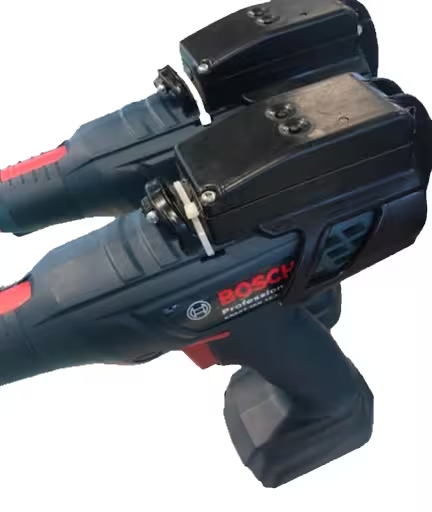
In the smart station architecture, cordless tightening tools, hand tools, and auxiliary equipment operate in a connected manner. Each tool is associated with a specific station and vehicle, and all usage data is recorded on a vehicle basis.
Tightening counts, operation sequences, and tool usage data are monitored in real time. When a deviation from the defined process is detected, the system automatically intervenes.
Wireless Communication R&D (Zigbee & Wi-Fi)
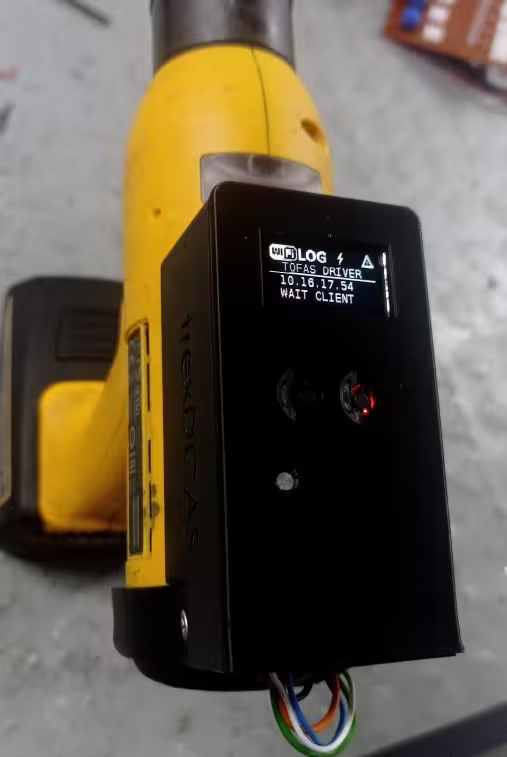
As part of this work, I personally conducted the R&D activities for the Zigbee- and Wi-Fi-based wireless communication infrastructure. The main objective was to build a stable, energy-efficient, and sustainable communication architecture suitable for industrial environments.
Zigbee was preferred for battery-powered equipment due to its low power consumption and support for multi-device management. I performed field tests focusing on connection stability, interference, and reconnection scenarios.
Wi-Fi was used for high-speed data transmission between stations and upper-level systems such as MES and data collection servers. Real-time data synchronization, logging, and centralized monitoring were provided through this structure, with extensive testing for network interruptions and recovery scenarios.
The hybrid use of Zigbee and Wi-Fi optimized both energy efficiency and communication continuity.
Poka-Yoke and Line Control Mechanisms
A significant part of the work focused on Poka-Yoke (error-proofing) mechanisms. The system automatically detects and blocks vehicle progression when:
The defined tightening count is not completed
An incorrect tool is used
The operation sequence is violated
This approach minimizes operator errors and ensures continuous production quality.
OPEN Protocol, Linux and Raspberry Pi Based Smart Data Processing
During the project, I worked with OPEN Protocol, widely used in industrial tightening systems, enabling real-time acquisition and transfer of tightening results, status information, and error codes to upper-level systems.
The system infrastructure was based on Linux, where I worked on service management, network configuration, and data flow processes. Raspberry Pi-based edge devices were used to collect and pre-process station data.
In addition, I conducted experimental studies using neural networks for anomaly detection and fault analysis, contributing to a more predictive system behavior.
My Role in the Project
Within these works, I actively participated in the R&D, testing, and production processes of the new-generation P2P (Point-to-Point) communication version of the smart tightening system developed for TOFAŞ. The work was carried out at MSE Digital, where I was directly responsible for wireless communication tests, OPEN Protocol integrations, field validations, and production line implementations.