Industrial Carrier Board Design for Raspberry Pi CM4
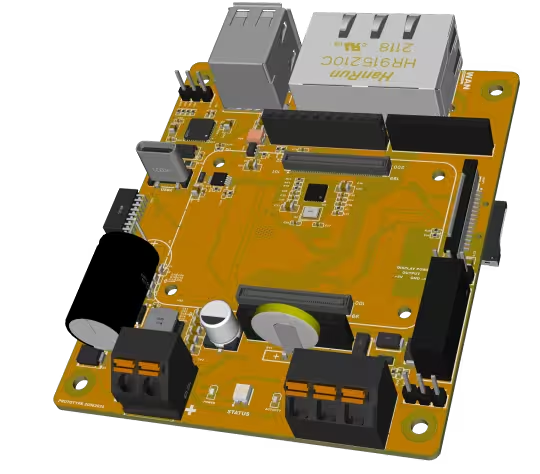
I summarize the industrial gateway–oriented carrier board design I developed based on the Raspberry Pi Compute Module 4 (CM4), along with my core approaches to high-speed PCB design. The main objective was to create a reliable, flexible, and expandable hardware platform capable of long-term operation in harsh industrial environments, featuring isolated communication infrastructure.
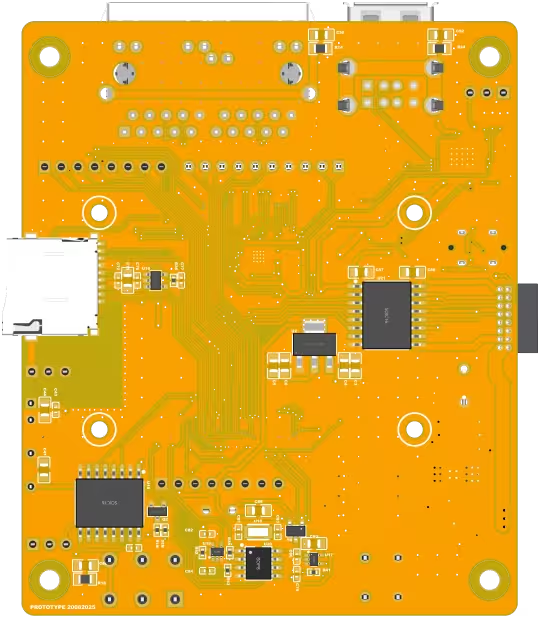
Project Objective
This board was designed to perform data acquisition, protocol conversion, and gateway functions in industrial environments. A modular structure was targeted, suitable for factory automation, energy monitoring, remote I/O systems, and custom communication solutions.
Hardware Features
Processor Module: Raspberry Pi Compute Module 4
Network Connectivity:
Dual Ethernet (1× 1 Gbps + 1× 100 Mbps)
High-speed, impedance-controlled differential pair routing
USB:
Dual USB ports
USB Type-C boot support
Industrial Communication:
RS485 Modbus communication
Full galvanic isolation (communication and power domains separated)
Power Input:
Wide-range 9–36 V DC industrial power input
Compatible with industrial power supplies
Display Interface:
- DSI LCD port (for touch or industrial display applications)
Expandability:
External SPI port located on the right side
Designed for custom external modules or devices
Mechanical Design:
- Form factor compatible with standard industrial enclosures
Storage and Boot Options:
Boot via USB Type-C
microSD card support
Internal eMMC for operating system and data storage
Industrial Gateway Use Cases
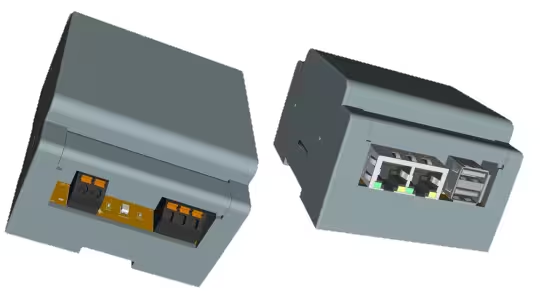
This carrier board can be reliably used as:
Modbus RTU ↔ Ethernet / TCP converter
Data acquisition and IoT gateway
Local network to cloud integration device
Edge computing unit in industrial control panels
Expandable system with custom SPI-based sensor or control boards
PCB Design and High-Speed Design Approach
The PCB design was carried out in accordance with high-speed design principles:
Controlled impedance routing for Ethernet and USB
Differential pair length matching
Multilayer PCB structure with separated power, ground, and signal planes
Placement and grounding strategies to minimize EMI / EMC risks
Safe creepage and clearance distances between isolated domains
Special emphasis was placed on stable operation of the CM4’s high-speed interfaces and noise immunity in industrial environments.
Conclusion
This Raspberry Pi CM4-based carrier board was designed as a field-ready gateway solution that combines high-speed communication with industrial-grade isolation. Thanks to its modular architecture and expandable SPI interface, the platform can be reused and adapted for various future projects.